
An Art Exhibition by Dhiraj Hadole, Pravin Waghmare, Swapnil Sangole
From: 23rd to 29th December 2025 at Jehangir Art Gallery, Auditorium Hall, 161-B, M.G. Road, Kala Ghoda, Mumbai
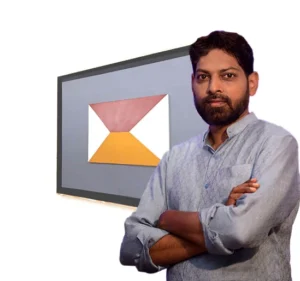
Dhiraj Hadole
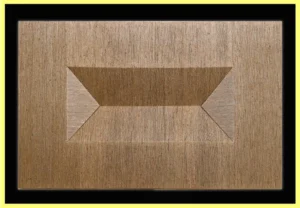
Dhiraj Hadole’s work enters the long history of geometric abstraction not through utopian rigidity or formal bravado, but through a quieter, inward recalibration of what geometry can hold within. Where early modernist abstraction like Constructivism, De Stijl, Suprematism, often positioned geometry as a universal language detached from subjectivity, Hadole belongs to a later, more reflective strain of abstractionists that allow structure to coexist with memory, affect, continuity, and care.
His compositions recall the disciplined clarity of hard-edge abstraction, yet they resist its doctrinaire coolness. Unlike the mathematically assertive geometries of artists such as early Bauhaus painters, Hadole’s planes feel lived-in. They are not declarations; they are settlements. The edges meet without aggression, and colour behaves less like a system and more like a mood. This places his work closer to artists who softened geometry through experience, where colour interaction became psychological rather than purely optical, like Josef Albers.
At the same time, Hadole’s surfaces carry an unmistakable emotional register that aligns him with a lineage of felt abstraction, artists who used reduction not to erase feeling, but to distil it. One senses an affinity with quiet grids, where repetition functions as a form of attention rather than control. Hadole treats geometry as a meditative framework, a way to steady the mind rather than dominate it. It is evident in the way he constructs the wood stretcher, and drapes the canvas over it deftly, almost like one was reenacting a childhood memory, shaping it to precision.
The stitched and layered qualities in his work also introduce a material memory absent from classical geometric abstraction. Here, the work quietly diverges from Western modernist purity and moves toward a more indigenous abstraction; one shaped by domestic knowledge, textile logic, and inherited labour. Hadole’s quilt-inspired works situate him within a broader global shift where abstraction absorbs cultural specificity without becoming illustrative of the milieu. The geometry does not reference craft directly, yet it carries its ethics: patience, repair, assembly, warmth.
Emotionally, these works do not aim for expressionism. There is no outburst, no rupture. Instead, they emerge as a feeling that can exist in equilibrium, that care can be structured, that intimacy can be measured without being diminished. This places Hadole in dialogue with post-minimalist sensibilities, where restraint becomes a moral position rather than an aesthetic trick.
What makes Hadole’s paintings quietly radical is their ethics. They insist that stability is not the enemy of life. They argue, without preaching, that a composed surface can still carry intimacy, that precision can still be soft. Dhiraj Hadole’s geometry is not about control for its own sake; it is about building a space where inner turbulence can settle without being forgotten. In that sense, his work aligns with the exhibition’s spirit of Chitta–Chitra: the mind and heart translated into image, not through confession, but through construction.
These are paintings that behave like shelters. They do not shout to be understood. They stay, they steady, and they reward the viewer who is willing to slow down and meet them at their pace.
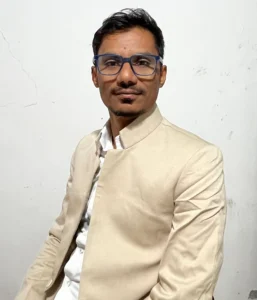
Pravin Waghmare
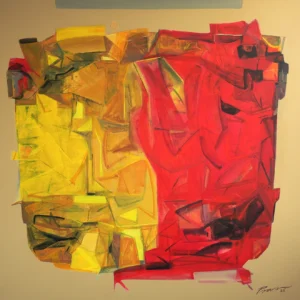
Every moment in daily life carries a visual message forms, colors, textures, and emotions that quietly communicate with the mind. These subtle impressions touch me deeply, and from this inner vibration my creative journey begins.
In nature, in society, and in ordinary everyday scenes, I sense a silent narrative waiting to be heard. I search for this hidden whisper in shapes, hues, textures, and movements, and these experiences naturally evolve into the visual language of my art.
Although the forms in my paintings appear abstract, their essence is rooted in reality. The visible world constantly speaks to us through unspoken feelings, quiet thoughts, and fleeting emotions. When these internal experiences long to be expressed through color and form, my process of painting unfolds.
Just as a ball rebounds back when it strikes a wall, every encounter in life every sight, touch, sound, and sensation returns to me in the form of inspiration. Each line, each shade, each texture in my work is an echo of lived experience.
Everything I see, feel, and absorb transforms into my artwork through an honest interplay of form, color, emotion, and texture. My artistic attempt is always to express these experiences with sincerity and depth.
Swapnil Vilasrao Sangole
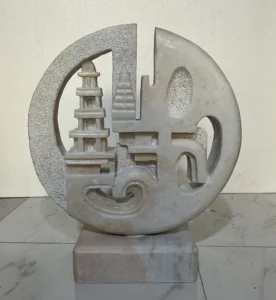
As I delve further into the practice of sculpture, I find myself increasingly drawn to the tensions between permanence and impermanence, tradition and innovation, silence and expression. Indian temple architecture, with its intricate carvings and spiritual gravitas, offers not only aesthetic inspiration but a philosophical lens through which I view the world. My work seeks to carry forward this spirit-not through replication, but through reinterpretation.
Working with stone and other tactile materials allows me to engage in a dialogue with time itself. Each chisel mark, each polished surface becomes a meditation on continuity and rupture. In this way, my sculptures serve as bridges-between the material and the metaphysical, the personal and the collective. I aim to create works that are not only seen but felt-embodied experiences that resonate across boundaries of language, geography, and belief.
In recent years, my focus has expanded to include collaborative practices and community-based projects. By inviting participation and co-creation, I aim to democratize the sculptural process, allowing multiple voices to shape the final form. These collective works reflect shared concerns, dreams, and histories, and are often displayed in public spaces where art can engage with everyday life.
Ultimately, my practice is guided by a desire to honor the sacred while confronting the profane. I believe in the power of sculpture to bear witness, to question, and to heal. Whether through monumental installations or intimate objects, I strive to craft spaces -physical and emotional-that encourage introspection, resistance, and renewal.
