
COLLECTIVELY INDEPENDENT 2026 Beyond the Visible The Exhibition Ends, But the Dialogue Continues
Collectively Independent 2026 — Beyond the Visible, presented by Inner Konnect Art (IKA) at the Visual Arts Gallery, India Habitat Centre, New Delhi, from 20–25 August 2026, has come to a close. Yet, for the four artists, the conversations that began within the gallery continue to resonate.
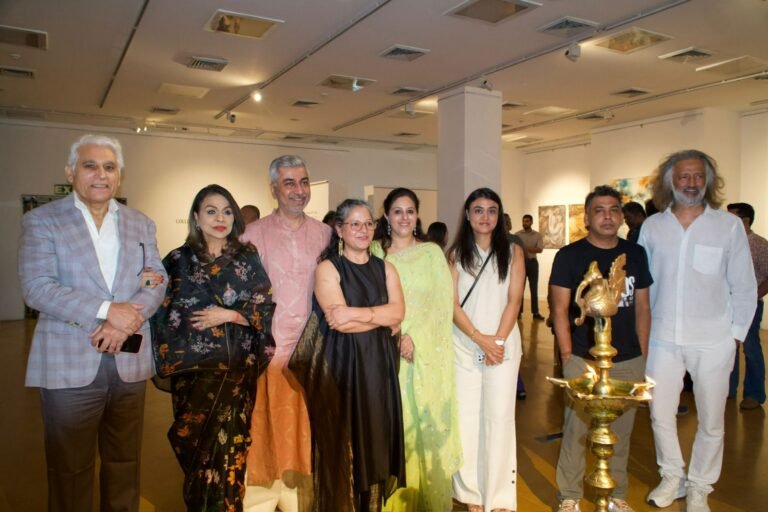
At the heart of Collectively Independent is a simple but important idea: art by artists and for artists. It is a platform that allows independent artistic voices to come together without requiring them to conform to a common style, medium or visual language. What connects them is not similarity, but the willingness to share, question, observe and engage.
This year’s exhibition brought together Bharti Verma, Ramos, Ruchi Chadha and Sapna Gupta—four artists with distinctly individual practices, yet a shared commitment to an honest and sustained engagement with art. Their works moved across figuration, abstraction, nature, memory, emotion, material and perception, encouraging viewers to look beyond what is immediately visible.
The exhibition was inaugurated in the presence of distinguished guests of honour Ms Raseel Gujral Ansal, Mr Naveen Ansal, Mr Samar Jodha and Mr Manu Mansheet Rai, whose presence and engagement added significance to the opening. Their responses to the works and conversations with the artists reflected the importance of creating spaces where art can be encountered directly and discussed openly.
Throughout the exhibition, the gallery became a space of interaction. Artists had the opportunity to speak about their processes, while visitors brought their own readings and experiences to the works. The appreciation extended beyond the immediate art fraternity, with collectors, designers, cultural personalities, artists, art lovers and members of the public visiting the exhibition and engaging with the works.
A particularly meaningful visit was that of Shri Anjani Kumar Singh, Director General of Bihar Museum, whose engagement with the exhibition and thoughtful observations offered the artists an important institutional perspective. His appreciation of the individual practices and the larger idea of bringing independent voices together added depth to the ongoing conversation around contemporary art and artistic platforms. (Bihar Museum)
Another special visitor was Zelda Cheatle, the internationally recognised curator, editor and lecturer in photography, whose long association with contemporary photographic practice and international art institutions has made her an influential voice in the field. Her visit was especially encouraging for the artists. She spent time looking closely at the works, interacting with the artists and sharing valuable insights. Her appreciation of the sincerity and individuality of the practices was both generous and meaningful. (Zelda Cheatle
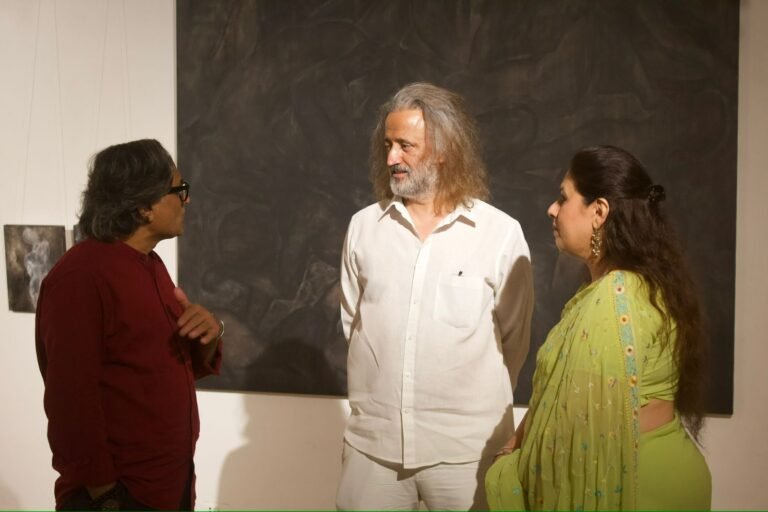
Four Artists. Four perspectives
Bharti Verma continues to investigate the psychological and emotional presence of the human figure. Her largely restrained palette, layered surfaces and often anonymous or partially concealed figures create a space where the individual becomes universal. Her paintings are less about depicting people than evoking states of being—memory, silence, vulnerability, connection and unnamed emotion.
Ramos approaches the painted surface through an intuitive and expressive language, allowing gesture, form and colour to become carriers of feeling. His works invite the viewer to move beyond literal interpretation and respond to the energy and atmosphere contained within the composition. There is an immediacy in his practice that keeps the work open to multiple readings.
Ruchi Chadha brings nature, particularly the lotus, into a contemplative visual language. Her works move between observation and abstraction, using water, reflection, movement and fluidity as both visual elements and metaphors. The lotus becomes more than a botanical form—it becomes a meditation on resilience, renewal and transformation.
Sapna Gupta works through abstraction, texture and an intuitive dialogue with nature. Her layered surfaces, spontaneous gestures and earthy vocabulary allow the paintings to evolve organically. Rather than offering a fixed image, her works create an experience—one in which material, movement and light suggest inner landscapes and the possibility of transformation.
Together, the four practices demonstrate that independence in art does not mean isolation. Each artist retains a distinct voice, while the juxtaposition of their works creates unexpected conversations between figure and abstraction, nature and memory, surface and depth, silence and gesture.
And perhaps this is what Beyond the Visible ultimately sought to do: to encourage looking beyond the obvious and to recognise the emotions, experiences and ideas that exist beneath the surface of an artwork.
The response to the exhibition reaffirmed the value of such a space. Every conversation, observation, question and personal interpretation became part of the exhibition itself. For the artists, these encounters are as important as the works on the walls.
As the gallery now falls silent and the artworks return to their individual journeys, Collectively Independent 2026 does not feel like an ending. It feels like a pause.
The paintings may have left the gallery, but the thoughts they generated remain—with the artists, with the viewers, and within the continuing community of IKA.
The exhibition ends. The dialogue continues.
