
The Quartz Collective Presents Parallels of Perception a Group Exhibition at Triveni Kala Sangam, New Delhi
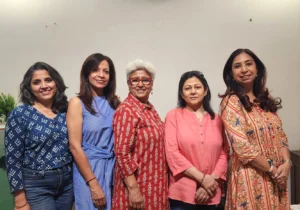
Featuring Artists of The Quartz Collective
Nitasha Jaini, Gitanjali Kashyap, Ritu Aggarwal, Ritu Singh , and
Shikha Gupta
Curated by Georgina Maddox
Throughout history, women have relied on collective action to secure agency, education, and representation in systems that frequently erased their achievements. When women artists unite, they form potent networks of resistance, mutual support, and cultural upheaval. These collectives have consistently contested the male-dominated art canon, elevated the value of traditional “women’s work,” and created safe spaces where female voices can flourish. The Quartz Collective is one such group, that has resulted in the coming together of several artists who are women and who share a parallel journey of artistic perception and expression. It is an ongoing effort, and this is their first group exhibition.
As a collective voice and as individual artists, they have articulated themselves in a manner that touches upon several topics and styles. They have employed the minimalism of linear abstraction, the narrative spun by figuration or the pure expression of colour and texture. Let us begin unraveling their narratives and concerns.
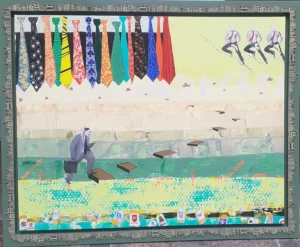
To begin with let us look at the works of figurative artist Nitasha Jaini (9599071713) her creative expression for this project is associated primarily with the male figure, dressed in a suit and tie, lugging his suitcase and climbing the staircase of corporate capitalism. While the critique of male ‘machismo and heroism’ is in-built in his posturing and stride, there is also compassion towards the burden of lifting patriarchal ideology. Men are often dominated by the vice of gender stereotyping that limits them. They are frequently forced, from childhood itself, to prescribe to roles that restrict men from expressing their more vulnerable sides. These societal pressures place them in suffocating positions upon the corporate ladder, with little or no escape and they harden in the glare of blinding city lights and apathy. Nitasha has done her Masters in Fine Arts, B.B.K.D.A.V. College, Guru Nanak Dev University, Amritsar, and she brings the flavor of Punjab into these figurative works, with bright colours and lively strokes. Inspired by the cityscape of Delhi, its buildings and rising population, Nitasha uses the metaphor of the metropolis to outline the fetters of city life, that both enable and as well as obstruct.
To unpack this statement, let us look at one particular canvas. The border of the canvas is hemmed in by buildings. On the top left side of the canvas an array of ties hangs in a mock decorative manner almost like banners and flags of the conqueror of the territory, while on the right side, three clip-art transfers of a man in a tie hurrying up a skeletal staircase speaks of the race to get ahead. In the central space of the canvas, we are presented with another male figure who appears less spry and more over-burdened as he trudges up the staircase while looking at his phone. The top of his head appears to explode and to mingle with the backdrop of the composition, stating that perhaps his thoughts are no longer his own. In the backdrop are the emblems of victory podiums, designating first second and third positions that reappears in several spaces. Its repetition becomes oppressive and yet it provides the structure of retention. This canvas says it all, as it critiques ambition that dismantles individuality, it questions the shapes and structures dictated by patriarchy.
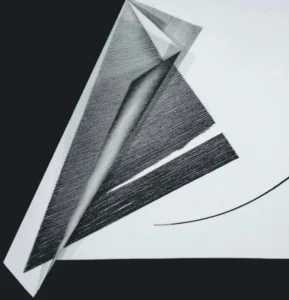
On the other end of the spectrum are the measured, meditative, soothing repetition of lines, shades and structures, explored by Gitanjali Kashyap, (9818097391) in her works, done on paper and in some instances on canvas. Gitanjali is an abstract artist who is inspired by the likes of Nasreen Mohammadi, and she draws from her own journey from figuration to abstraction, that borders on Op art, or optical art, a mid-20th-century art movement, that investigates visual perception and often tricks the eye into seeing 3D effects. For this exhibition we have chosen an array of Gitanjali’s work that goes back to 2013 progressing all the way to her most recent solo Scripted Silences.
What one would notice upon examining these different bodies of work is the continuity, the inquest for interiority and strength that marks their progression. Employing the minimal language of line, lighting and shade, and the depth of perspective, Gitanjali creates waves of linearity, creating a geometry of forms that tunnel one into the other in a continuity that is almost dizzying. There is a distinct sense of motion, a coming and going, through the planes of the painted and graphite surfaces.
Light and shadow play an important role and the raised geometric forms like triangles, throw a shadow upon the surface, becoming a third shape that inhabits the surface of the work. It is not a just the formalism of these shapes but their sacred geometry that Gitanjali follows. Despite feeling initially lost in the maze, the viewer may find a sense of direction and inner strength, while spending time with her work.
In the recent exhibition Scripted Silences hosted at Triveni Gallery, curated by Lubna Sen, Gitanjali has been inspired by the compelling practice of inscribing ‘Ram Naam Lekhan’ in her work. This is not just art but an act of devotion where the artist inscribes repeatedly the name of Shri Ram, to evoke the power of the deity to protect and alleviate life’s challenges. It brings to the work a quiet resilience and becomes a powerful evocation.
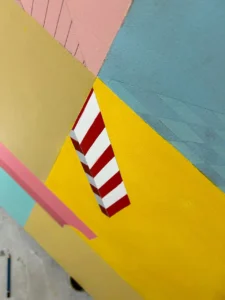
Ritu Aggarwal’s (999910899) engagement with geometry is more playful in her approach as she deconstructs architectural forms, creating patterns, structures and tromp-de- oeil that is not photorealistic rather it ‘fools the eye’ with the simple geometry of lines and colours. Using the candied striped shop awing she plays with perspective in a manner that the composition changes when viewed from a different angle, turning things on its head and disorienting the viewing in a manner that is enjoyable, but can also be intense and severe, when required. In this exhibition she displays a variety of urban grids, and ‘silent negotiations’ that bring together architectural forms like stairs, tympanums, archways and doorways into conversation with each other. She has experimented with colour schemes that have also shifted to lighter tones and with mixed media. In some works, she has even stitched surfaces, creating a third dimension and texture.
Her work in geometric abstraction, illusionism and hard-edged painting has been shown around the world, and over the last 20 odd years she has participated in various artistic endeavors and commission projects. She has worked on a wall mural in New Delhi in 2013, receiving the 5th AIFACS Annual Digital Award in New Delhi in 2015, and she has earned the Prafulla Dahanukar Art Foundation City Merit Award in 2018. She completed the Mark Rothko International Art Symposium in Daugavpils, Latvia in 2019. Her travels bring a variety of influences to her work.
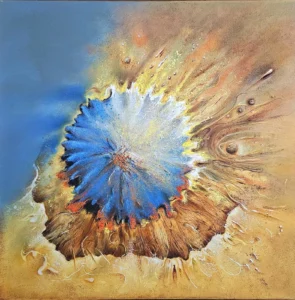
Ritu Singh (9821274758), brings to her work the mysticism of the ocean, the cosmic thunder of the planets and stars with the vitality throbbing under of the core of the earth, in cataclysmic mix of colours and textures. Ritu’s approach to the idea of a dramatic upheaval is a wonderful mixture of the positive and negative forces of the universe.
A cataclysm in Ritu Singh ’s eyes is a monumental, paradigm-shifting event that produces profoundly beneficial outcomes. She does however hone in on the darker side of man-kind’s interference with the rhythms of nature, where the fish do not escape the fisherman’s nets (overfishing) and the planets heat up as a result of the overwhelming deforestation and misuses of nature’s bounty—in other words the appalling global warming that has thrown much of our earth’s balance into chaos.
Ritu translates over 32 years of her global travel into her ever-evolving art style. She draws parallels between the textures of nature – snow, ash, foam, smoke, ice – and the textures of the human condition – desire, dilemma, distortions, through her mixed media work that combines, acrylic, oil, and melted crayon.
Ritu was part of the WAKE Biennale in Senegal, alongside elite international symposiums across Turkey, Spain, Egypt, Romania, Albania, and Cyprus. As a curator, Ritu has helmed key exhibitions, including the Indo-Türkiye Art Confluence and corporate shows for Audi and ICAC Gallery. Her accolades feature the Lalit Kala Akademi National Merit Award and the Punjab Lalit Kala Akademi State Award. An institutional academic, she holds a Master’s in Fine Arts, specialized certification in Art Criticism, and has mentored over 1,500 students through her institute, Studio Vermillion. Born in Amritsar, forged in Mumbai, she currently creates from her studio home in New Delhi.
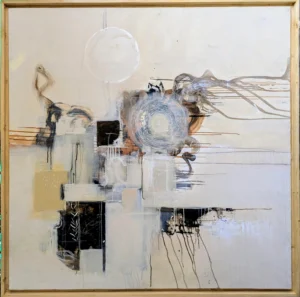
Shikha Gupta (9910994310), rounds off this artistic experience with two wonderful collaborative scrolls and a body of canvases that look into the healing qualities of art, through a sensitive use of abstraction and colour. Shikha is an artist with a diploma in fine arts from the Nationale École des Beaux-Arts, Paris, and she holds a master’s degree in art therapy, hence her works often explore the expressive power of art to rectify underlying trauma.
‘Now I hear You’, is a mediative scroll employing soft colours, found objects and text that brings to the fore the forgotten dreams and ambitions and the sheer presence of members of a tribe de-notified by the British in the 1800s. As part of their cruel strategy to conquer the Indian colonies, the British colonial government systematically “notified” hundreds of nomadic, pastoral, and indigenous people as criminals by birth. The colonial administration introduced the draconian Criminal Tribes Act of 1871 to control populations that lived ‘outside the settled agrarian system’. Because these nomadic groups were harder to tax, monitor, and govern, the British labeled them as “hereditary criminals”.
Consequently, it has taken decades to bring the members of these tribes from Indore often known as Vimukta Jatis, out of the trauma and oppression fostered by this dastardly Act. Shika uses art to get the community members to express themselves since they were even hesitant to draw or be creative. Working with bandage, shells, soil and feathers alongside muted colours and text she got the tribals to create art that is gently emancipating, without being too heavy or preachy. Their newfound unfettered art can be ‘Heard and Seen’ with her tender interventions, of text, colour and form.
The project involves two other art therapists, Anushree and Ruthika. In her own personal body of work, Shikha explores half circular forms and gentles colours. The half circles are important because it evokes energy that is ‘bursting’ out of the confines of the circle, much in the manner that women, oppressed by patriarchy are bursting out of the limitations drawn around them to hem their creative energies in and suppress them. Like the work she did with the tribals, these works too are marked with the gentle energy that she possesses, that is soft on the eyes, yet powerful in its statement.
One could say that overall, these works by these women artists is much like their persona, soft yet powerful, engaging the viewer in gentle conversations that linger long after one has viewed the artwork. Their inclusive nature and their forbearing modes of persuasion stay with one in manner that is long lasting and commands respect without raising their voice.
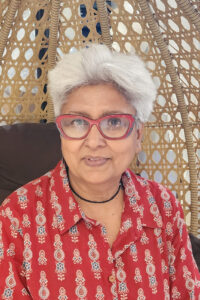
Georgina Maddox
Art Critic/Curator
