
Renowned artist Jain Kamal's Retrospective show in Jehangir Art Gallery from 26th May to 1st June 2026
A Spiritual Journey of an artist
Senior artist Jain Kamal’s retrospective at Jehangir Art Gallery, bringing together 101 works, positions itself within an onerous yet compelling proposition: the translation of the ‘Namokar Mantra’ from an ethical utterance into a visual system. In Jain philosophy, this mantra is not supplicatory but hierarchical and ontological. It acknowledges perfected states of being rather than invoking intervention. Its recitation is an act of alignment, a recalibration of the self toward equanimity, restraint, and self-knowledge. The exhibition’s premise rests on extending this inward calibration into the domain of the visible.
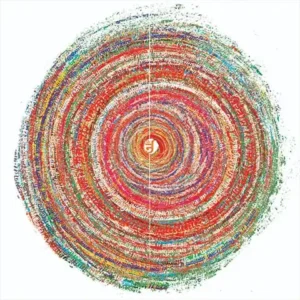
Jain Kamal’s practice consistently mobilises script as structure rather than inscription. Letters accumulate into vortices, grids, and concentric dispersals, where language begins to behave as matter: compressing, radiating, dissolving. Elsewhere, manuscript-like grounds and typographic densities evoke the labour of chant-like repetition central to Jain meditative practices, where meaning is not delivered instantly but sedimented through sustained attention.
The reference to Jain cosmology, particularly the notion of cyclical existence and gradations of consciousness, is deployed not as illustrative narrative but as structural principle. The works often stage a movement from dispersion to centre, from multiplicity toward a tentative stillness. This compositional logic mirrors the ethical trajectory embedded in Jain thought: the gradual attenuation of karmic accretions through discipline and awareness.
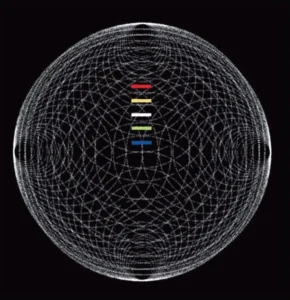
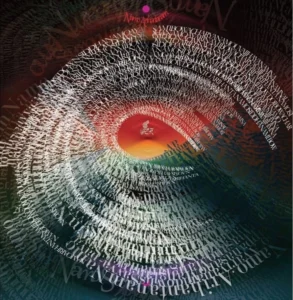
Crucially, the exhibition’s invocation of global peace emerges as a derivative condition. Within Jain epistemology, peace is neither negotiated nor imposed; it is the by-product of an interior equilibrium achieved through self-regulation. Jain Kamal’s visual strategy: repetition, containment, and centripetal focus, attempts to materialise this proposition: that the ordering of perception precedes the ordering of the world.
The retrospective also folds into itself several parallel strands from the artist’s long professional trajectory. A section titled ‘Namokar Mantra for World Peace’ extends the exhibition’s meditative axis into a broader public-facing rhetoric of ethical coexistence. Another body of work, ‘Ek Fakir Se Doosra Fakir’, presents glimpses from a series of approximately 250 paintings centred on Prime Minister Narendra Modi, positioning political portraiture and public image-making within the artist’s wider engagement with symbolic identity and circulation. Alongside these works, archival material from nearly fifty-five years of design practice for around sixty national newspapers and periodicals is also displayed, foregrounding Jain Kamal’s sustained involvement with print culture, graphic layout, and visual communication across editorial platforms. An Original design portfolio featuring 55 years of work for 60 national newspapers and periodicals will also be on display.
This retrospective, therefore, is best understood not as a devotional display, but as an extended inquiry into whether a rigorously inward philosophy can sustain a contemporary visual language without losing its ethical density and, moreover, how it might extrapolate into a globally aligned peace-making process.
